










Global Travel News
Campaigns Bring Cage-Free Demands to Thailand’s Streets
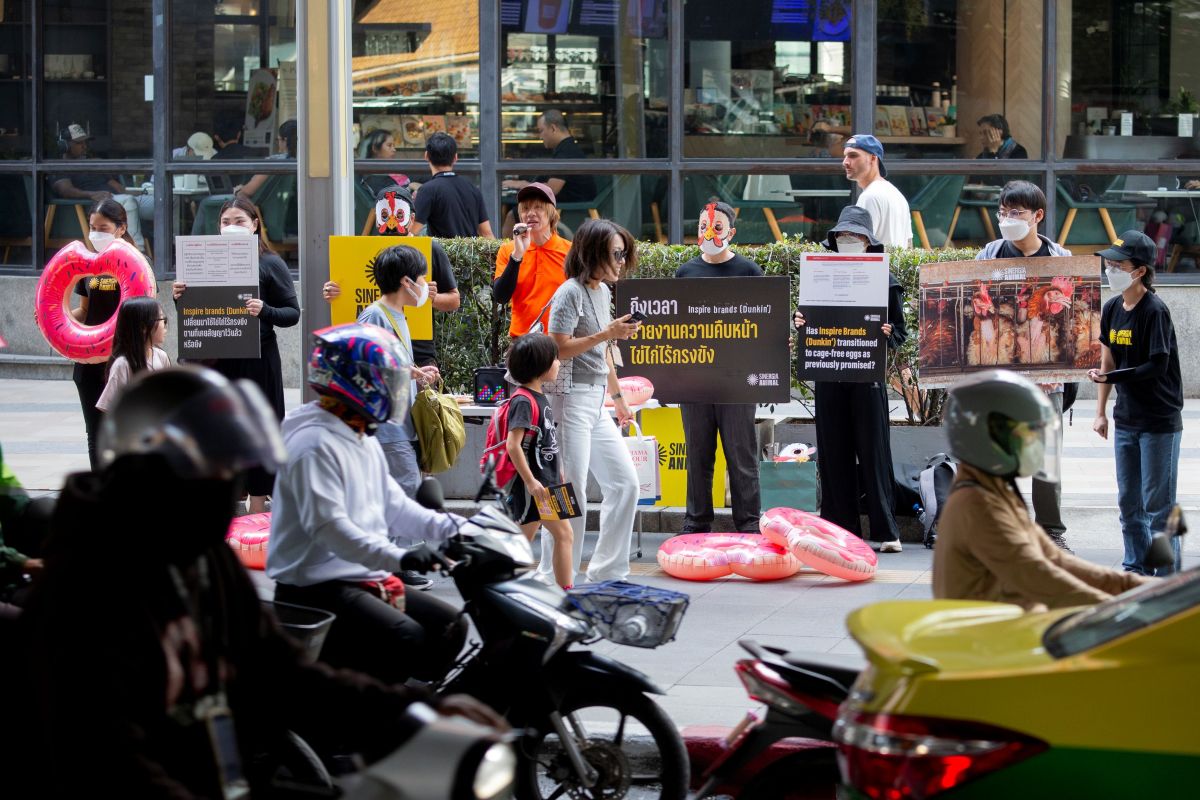
On a typical afternoon in Bangkok, shoppers and commuters have recently been met with an unusual sight: figures dressed as chickens standing silently in some of the city’s most recognizable public spaces. At Benchasiri Park, outside the Bangkok Art and Culture Centre, and near major commercial districts.
These actions reflect a broader shift emerging across the Global South, where civil society groups are pairing corporate engagement with public-facing pressure to secure reforms in rapidly industrializing food systems.
Industrial Expansion and Rising Scrutiny
Globally, demand for animal products continues to rise. Meat production has nearly tripled over the past 50 years, and beef consumption alone is projected to increase by around 80 percent between 2010 and 2050, according to research cited by Sentient Media. Much of this expansion is occurring in low- and middle-income countries, where industrial livestock systems are scaling rapidly.
Thailand is one of Southeast Asia’s leading agricultural producers and a key player in regional food markets. Its egg industry still relies predominantly on the confinement of laying hens in narrow wire cages. Approximately 51.55 million laying hens in Thailand are kept in cages for their entire productive lives, where each hen typically has less space than an A4 sheet of paper. In such systems, hens are unable to fully spread their wings, perch, or engage in natural nesting behaviors, conditions widely associated with stress and health complications.
Asia produces more than 65% of the world’s eggs, and cage systems remain widespread across much of the region. At the same time, international markets are gradually transitioning toward cage-free production. The European Union banned conventional battery cages in 2012, and today more than 60% of laying hens in Europe are raised in cage-free systems.
As global standards evolve, expectations around sourcing practices are increasingly extending into emerging markets.
Sinergia Animal, an international animal protection organization working across countries in the Global South, has been engaging with major companies to strengthen animal welfare standards within their supply chains.
In 2025, the organization worked with 36 companies across 9 countries to advance transparency around egg sourcing and support the development of cage-free commitments.
In Thailand, this engagement has contributed to cage-free commitments from IKEA Thailand and ONYX Hospitality Group. Advocates note that several companies with commitments deadlines set in 2025 have yet to publish detailed progress updates.
“Across the Global South, we are seeing companies respond to rising consumer expectations around food ethics,” said Saneekan Rosamontri, Managing Director of Sinergia Animal in Thailand. “Thailand is part of that shift. As the country’s food sector continues to grow, sourcing standards are becoming increasingly relevant for businesses operating here.”
The Rise of Public Accountability
Thailand’s mobilizations reflect an evolving advocacy approach that combines corporate engagement with visible public accountability.
The increase in street actions also comes amid a broader global rise in social demonstrations. According to global protest tracking data, more than 140,000 protests were recorded worldwide in 2024, roughly 15 percent more than the previous year, signaling heightened public engagement across diverse social and environmental issues.
“Consumers increasingly expect transparency. Our campaigns aim to support companies to move beyond announcements and demonstrate measurable progress within their egg supply chains,” added Saneekan.
Thailand’s status as a major agricultural producer makes these developments particularly significant. Corporate sourcing decisions influence production standards and send signals throughout regional supply chains.
Globally, hundreds of multinational companies have adopted cage-free sourcing commitments in response to consumer demand and advocacy efforts. As implementation advances in some markets, attention is increasingly turning toward emerging economies where industrial production continues to expand.
Campaigners say Thailand has the opportunity to strengthen corporate transparency and accelerate cage-free implementation within Southeast Asia.